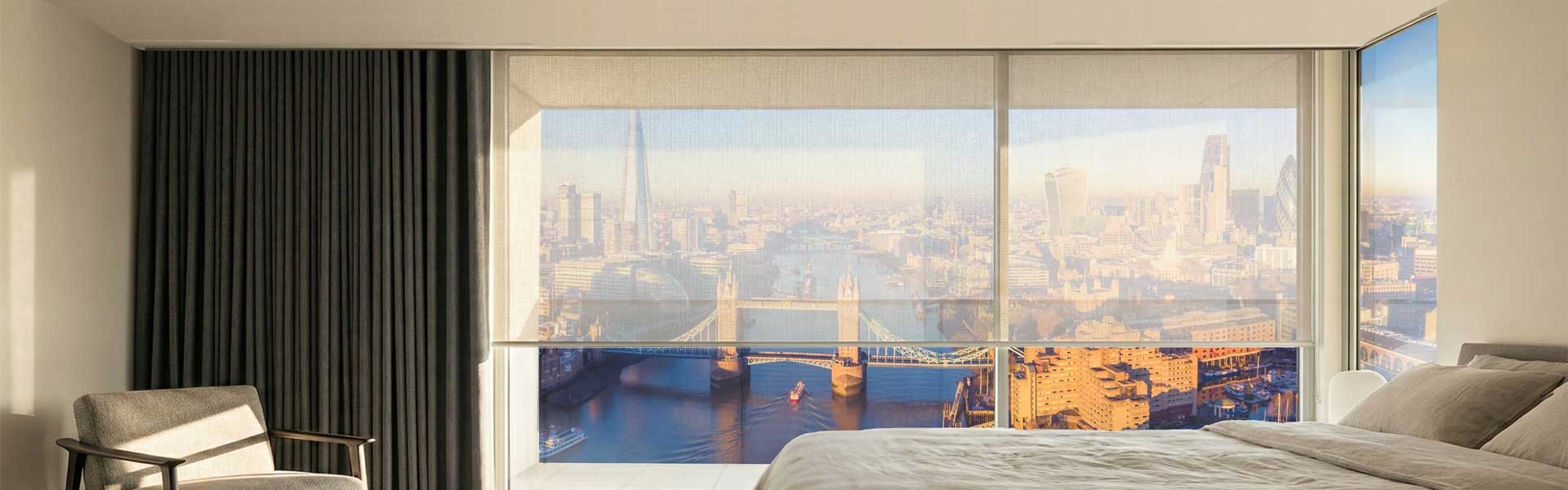
Resi Window Treatment Layering: Why Single-Layer Solutions Fall Short
In the push to deliver new BTR, PBSA and other residential projects on budget amid a background of rising costs, it can be tempting to go hard on value-engineering the ‘final touches’. When done poorly, this can result in delays and additional costs post-build, as landlords and developers grapple with remedial works.
Take, for example, window treatments. On face value, the minimum requirements might be a single layer — usually just curtains for the bedroom and blinds for the living area.
While this ticks a box in the short-term, it creates a functional gap that impacts tenant wellbeing, rent value, energy efficiency, and even security. Correcting this post-construction usually requires disrupting occupiers, scheduling tradespeople around access times and drilling holes in finished apartments.
The Problem with "Curtains Only"
When tenants have only curtains, they have to close them during the day for basic privacy or glare control. This has immediate negative knock-on effects:
- Wellbeing & Solar Gain: It blocks out essential natural daylight and passive solar gain, creating a gloomy indoor environment and heightened demand on heating systems during the winter.
- Security Signalling: Closed curtains during the day act as a beacon to burglars, signalling that the occupant is away.
Best Practice: Strategic Layering
To truly deliver on comfort and function, we need to view window treatments as a dual-system that gives occupants control of their personal environment, through day and night:
- The Daytime Layer (Diffuse Blinds): Roller or sheer blinds provide essential privacy and glare reduction without sacrificing natural light. They allow the tenant to see out while preventing others from looking in.
- The Nighttime/Acoustic Layer (Curtains or Blackout Blinds): Heavy drapery provides the blackout conditions necessary for quality sleep, acts as a crucial acoustic buffer, and softens the hard surfaces typical in modern BTR apartments.
The Architect’s Challenge: Space vs. Function
The hesitation to specify layering often comes down to two factors: Space constraints (bulky bulkheads) and installation costs.
This is where the BlindSet system from Decor Systems changes the equation.
BlindSet is an off-site module available in single or twin-track header boxes. The system is designed specifically to solve the limitations of traditional methods:
- Seamless Integration: They can be installed directly into the ceiling void, creating a flush, minimalist finish.
- Cost & Time Efficiency: A prefabricated solution that simplifies the installation process.
- Reduces Scheduling Clashes BlindSet cassettes are typically fitted by the MF Ceiling/Drylining team.
- Removes Snagging: Fitted earlier than traditional systems, a cover keeps them clean during plastering and painting. All drilling is finished before the plasterboard stage.
- Dual Function: A twin-track BlindSet model accommodates both the privacy blind and the blackout curtain in one streamlined profile.
- Planned Flexibility: BlindSet can be supplied to site as a fully completed blind, while the Perimeos in-ceiling blind box is ideal for when you want to install only the ‘structural element’ in the base build/CAT A stage - and make final fabric decisions at CAT B fitout.
Don't let the window treatment be the weak link in your façade or residential interior design strategy. By specifying BlindSet early on in the design phase, you can save time and installation cost, and future-proof your window treatment options - while delivering excellence on your resi projects.